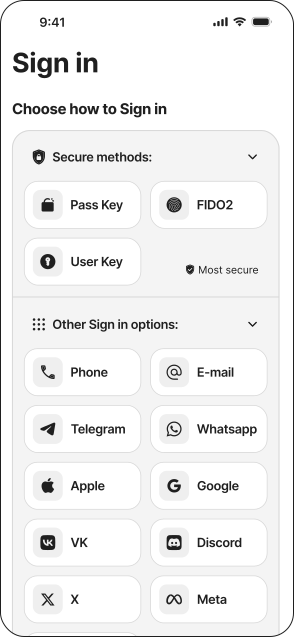
12 Auth Methods

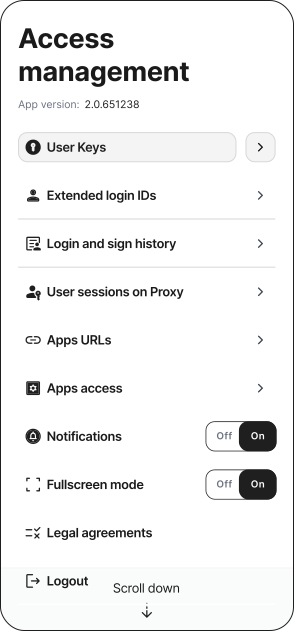
13 Admin Pages

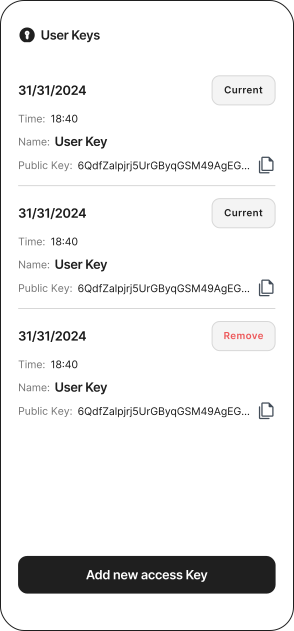
221 Unit Tests

3KB First Load
Solution

You’re building infrastructure instead of product.
Modern applications usually depend on multiple systems for authentication, routing, file storage, notifications, and admin operations. Each new service adds integration time, operational complexity, security risk, and another point of failure.
Authentication requires a separate provider.
Auth0, Keycloak, Firebase
Reverse proxying adds routing and security overhead.
nginx, Traefik
File storage needs its own service and rules.
S3, MinIO
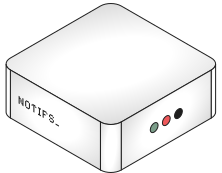
Notifications introduce more infrastructure and integrations.
Firebase, OneSignal
Admin tooling often becomes a custom internal project.
Custom Build or Retool





How it Works
One Gateway Between Users and Your Services.
AuthProxy sits at the edge of your application. Requests are authenticated, access policies are enforced, service context is injected, and traffic is routed to the correct backend.


Auth check - 12ms
Policy check - 4ms
Route resolve - 2ms
Learn more
Architecture
Authenticate requests before they reach your backend.
Enforce access control at the edge.
Inject useful context headers for downstream services.
Route traffic through one controlled entry point.
Capabilities
Everything your application needs — Built In.
AuthProxy combines core infrastructure capabilities into one gateway so your team can ship faster with less operational complexity.


Security
Secure by Design. Fast by Default.
AuthProxy protects the edge of your system while keeping architecture lean and predictable.
Threat Surface
Reduced 5x
via single edge gateway
3 KB first load
Optimized for PWA delivery
No external auth dependency chain
Single-process architecture


Developers
Built for Developers.
AuthProxy gives product and backend teams a clean way to add authentication, routing, and operational control without assembling multiple vendors and custom internal tooling.

API-first architecture


Works with any backend
Customizable auth flows

PWA-optimized delivery
AI-native / MCP integration
Federation-ready architecture
OPERATIONS
Run, Monitor, and Upgrade with Confidence.
Deploy AuthProxy with a predictable operational model and maintain visibility across health, telemetry, and version updates.








Docker-first deployment workflow
Built-in monitoring and diagnostics
OpenTelemetry integration
Clear versioning and release tracking
Documented limitations and upgrade path
FAQ
Frequently asked questions and documentation.
Key implementation questions answered with direct links to technical docs for deeper detail.
How quickly can we deploy AuthProxy in production?


Most teams can launch with Docker in under an hour. Start with the quick start flow, then add route and security policies incrementally.
Can we keep our existing backend services and auth flows?
Yes. AuthProxy sits in front of existing services as an edge gateway, so you can keep current backends and migrate auth/routing policies progressively.
How does AuthProxy handle performance and rate limiting?
AuthProxy uses a lightweight single-process model with PWA-optimized delivery and built-in request controls, including rate limiting at the gateway layer.
Does AuthProxy support AI/MCP integrations securely?
Yes. AuthProxy includes MCP-oriented integration patterns with edge authentication, scoped access, and centralized policy enforcement for AI-connected flows.